ABBEY ROAD (September 26, 1969)

From Wikipedia, Rolling Stone, Google and About.com ―
Abbey Road is the eleventh studio album by English rock band the Beatles, released on 26 September 1969 by Apple Records. The recording sessions for the album were the last in which all four Beatles participated. Although Let It Be was the final album that the Beatles completed before the band's dissolution in April 1970, most of the album had been recorded before the Abbey Road sessions began. A double A-side single from the album, "Something"/"Come Together", released in October, topped the Billboard chart in the US.
Abbey Road is a rock album that incorporates genres such as blues, pop, and progressive rock, and it makes prominent use of the Moog synthesizer and the Leslie speaker. Side two contains a medley of song fragments edited together to form a single piece. The album was recorded amid a more collegial atmosphere than the Get Back/Let It Be sessions earlier in the year, but there were still frequent disagreements within the band, particularly over Paul McCartney's song "Maxwell's Silver Hammer". John Lennon had privately left the group by the time the album was released and McCartney publicly quit the following year. A 16-minute medley of several short songs comprise the majority of side two, closing with the lyric "and in the end, the love you take is equal to the love you make".
Although Abbey Road was an immediate commercial success and reached number one in the UK and US, it initially received mixed reviews, some critics describing its music as inauthentic and bemoaning the production's artificial effects. Many critics now view the album as the Beatles' best and rank it as one of the greatest albums of all time. In particular, George Harrison's contributions, "Something" and "Here Comes the Sun", are considered to be among the best songs he wrote for the group. The album's cover features the four band members walking across a zebra crossing outside Abbey Road Studios and has become one of the most famous and imitated images in the history of recorded music. As of 2011, Abbey Road remains one of the Beatles' best-selling albums.
"Maxwell's Silver Hammer"
"Maxwell's Silver Hammer", McCartney's first song on the album, was first performed by the Beatles during the Let It Be sessions (as can be seen in the film). He wrote the song after the group's trip to India in 1968 and wanted to record it for the White Album, but it was rejected by the others as "too complicated".
The recording was fraught with tension between band members, as McCartney annoyed others by insisting on a perfect performance. The track was the first Lennon was invited to work on following his car accident, but he hated it and declined to do so. According to engineer Geoff Emerick, Lennon said it was "more of Paul's granny music" and left the session. He spent the next two weeks with Ono and did not return to the studio until the backing track for "Come Together" was laid down on 21 July. Harrison was also tired of the song, adding "we had to play it over and over again until Paul liked it. It was a real drag". Starr was more sympathetic to the song. "It was granny music", he admitted, "but we needed stuff like that on our album so other people would listen to it". Roadie and assistant Mal Evans played the anvil sound in the chorus. This track also makes use of Harrison's Moog Synthesizer, played by McCartney.
"Octopus's Garden"
As was the case with most of the Beatles' albums, Starr sang lead vocal on one track. "Octopus's Garden" is his second and last solo composition released on any album by the band. It was inspired by a trip to Sardinia aboard Peter Sellers' yacht after Starr left the band for two weeks with his family during the sessions for the White Album. Starr received a full songwriting credit and composed most of the lyrics, though the song's melodic structure was partly written in the studio by Harrison. The pair would later collaborate as writers on Starr's solo singles "It Don't Come Easy", "Back Off Boogaloo" and "Photograph".
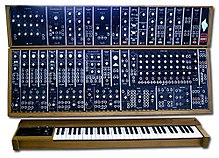
John Lennon played the Moog synthesizer's white noise generator to create the "wind" sounds at the end of "I Want You (She's So Heavy)"
"I Want You (She's So Heavy)" was written by Lennon about his relationship with Ono, and he made a deliberate choice to keep the lyrics simple and concise. Author Tom Maginnis thought the song had a progressive rock influence, with its unusual length and structure, repeating guitar riff, and white noise effects, though he noted the "I Want You" section has a straightforward blues structure.
The finished song is a combination of two different recording attempts. The first attempt occurred almost immediately after the Get Back/Let It Be sessions, in February 1969, with Preston. This was subsequently combined with a second version made during the Abbey Road sessions proper in April. The two sections together ran to nearly 8 minutes, making it the Beatles' second-longest released track. Lennon used Harrison's Moog synthesizer with a white noise setting to create a "wind" effect that was overdubbed on the second half of the track. During the final edit, Lennon told Emerick to "cut it right there" at 7 minutes and 44 seconds, creating a sudden, jarring silence that concludes the first side of Abbey Road (the recording tape would have run out within 20 seconds as it was). The final mixing and editing for the track occurred on 20 August 1969, the last day all four Beatles were together in the studio.
Side two
"Here Comes the Sun"
"Here Comes the Sun" was written by Harrison in Eric Clapton's garden in Surrey while Harrison took a break from stressful band business meetings. The basic track was recorded on 7 July 1969. Harrison sang lead and played acoustic guitar, McCartney provided backing vocals and played bass and Starr played the drums. Lennon was still recuperating from his car accident and did not perform on the track. Martin provided an orchestral arrangement in collaboration with Harrison, who overdubbed a Moog synthesizer part on 19 August, immediately before the final mix.
The song was not released as a single but still attracted critical praise. It has been featured several times on BBC Radio 4's Desert Island Discs, having been chosen by Sandie Shaw, Jerry Springer, Boris Johnson and Elaine Page. The Daily Telegraph's Martin Chilton said it was "almost impossible not to sing along to". Since digital downloads have become eligible to chart, it reached number 56 in 2010 after the Beatles' back catalogue was released on iTunes.
Harrison recorded a guitar solo for this track that did not appear in the final mix. It was rediscovered in 2012, and footage of Martin and Harrison's son Dhani listening to it in the studio was released on the DVD of Living in the Material World.
"Because"
"Because" was inspired by Lennon listening to Ono playing Ludwig van Beethoven's "Moonlight Sonata" on the piano. He recalled he was "lying on the sofa in our house, listening to Yoko play ... Suddenly, I said, 'Can you play those chords backward?' She did, and I wrote 'Because' around them." The track features three-part harmonies by Lennon, McCartney and Harrison, which were then triple-tracked to give nine voices in the final mix. The group considered the vocals to be some of the hardest and most complex they attempted. Harrison played the Moog synthesizer, and Martin played the harpsichord that opens the track.
Abbey Road Medley

The medley of songs on side two finished with "The End"
Side two contains a 16-minute medley of several short songs, recorded over July and August and blended into a suite by McCartney and Martin. Some songs were written (and originally recorded in demo form) during sessions for the White Album and Get Back / Let It Be, which later appeared on Anthology 3. While the idea for the medley was McCartney's, Martin claims credit for some structure, adding he "wanted to get John and Paul to think more seriously about their music".
The first track recorded for the medley was the opening number, "You Never Give Me Your Money". McCartney has claimed that the band's dispute over Allen Klein and what McCartney viewed as Klein's empty promises were the inspiration for the song's lyrics. However, MacDonald doubts this given that the backing track, recorded on 6 May at Olympic Studios, predated the worst altercations between Klein and McCartney. The track is a suite of varying styles, ranging from a piano-led ballad at the start to arpeggiated guitars at the end. Both Harrison and Lennon provided guitar solos with Lennon playing the solos at the end of the track, which Beatles author Walter Everett considers his favourite Lennon guitar contribution.
This song transitions into Lennon's "Sun King" which, like "Because", showcases Lennon, McCartney and Harrison's triple-tracked harmonies. Following it are Lennon's "Mean Mr. Mustard" (written during the Beatles' 1968 trip to India) and "Polythene Pam". These in turn are followed by four McCartney songs, "She Came in Through the Bathroom Window" (written after a fan entered McCartney's residence via his bathroom window), "Golden Slumbers" (based on Thomas Dekker's 17th-century poem set to new music), "Carry That Weight" (reprising elements from "You Never Give Me Your Money", and featuring chorus vocals from all four Beatles), and closing with "The End".
"The End" features Starr's only drum solo in the Beatles' catalogue (the drums are mixed across two tracks in "true stereo", unlike most releases at that time where they were hard panned left or right). Fifty-four seconds into the song are 18 bars of lead guitar: the first two bars are played by McCartney, the second two by Harrison, and the third two by Lennon, with the sequence repeating. Harrison suggested the idea of a guitar solo in the track, Lennon decided they should trade solos and McCartney elected to go first. The solos were cut live against the existing backing track in one take. Immediately after Lennon's third and final solo, the piano chords of the final part of the song begin. The song ends with the memorable final line, "And in the end, the love you take is equal to the love you make". This section was taped separately to the first, and required the piano to be re-recorded by McCartney, which was done on 18 August. An alternative version of the song, with Harrison's lead guitar solo played against McCartney's (with Starr's drum solo heard in the background), appears on the Anthology 3 album and the 2012 digital-only compilation album Tomorrow Never Knows.
"Her Majesty"
Unreleased material ―
Three days after the session for "I Want You (She's So Heavy)", Harrison recorded solo demos of "All Things Must Pass" (which became the title track of his 1970 triple album), "Something" and "Old Brown Shoe". The latter was re-recorded by the Beatles in April 1969 and issued as the B-side to "The Ballad of John and Yoko" the following month. All three of these Harrison demos were later featured on Anthology 3.
During the sessions for the medley, McCartney recorded "Come and Get It", playing all the instruments. It was assumed to be a demo recording for another artist but McCartney later said that he originally intended to put it on Abbey Road. It was instead covered by Badfinger, while McCartney's original recording appeared on Anthology 3.
The original backing track to "Something", featuring a piano-led coda,[31] and "You Never Give Me Your Money", which leads into a fast rock-n-roll jam session,[60] have appeared on bootlegs.
Production ―

An EMI TG mixing desk, similar to this one, was used in the production of Abbey Road
Abbey Road was recorded on professional eight-track reel to reel tape machines rather than the four-track machines that were used for earlier Beatles albums such as Sgt Pepper, and was the first Beatles album not to be issued in mono. The album makes prominent use of the Moog synthesizer, and the guitar played through a Leslie speaker. The Moog is not merely as a background effect but sometimes playing a central role, as in "Because" where it is used for the middle eight. It is also prominent on "Maxwell's Silver Hammer" (played using a ribbon strip) and "Here Comes the Sun". The instrument was introduced to the band by Harrison who acquired one in November 1968 and subsequently used it to create his Electronic Sound album. Starr made more prominent use of the tom-toms on Abbey Road, later saying the album was "tom-tom madness ... I went nuts on the toms."
Abbey Road was also the first and only Beatles album to be entirely recorded through a solid state transistor mixing desk, the TG12345 Mk I, as opposed to earlier thermionic valve based REDD desks. The TG console also allowed better support for eight-track multitrack recording, helping the Beatles' considerable use of overdubbing. Emerick recalls the TG desk used to record the album had individual limiters and compressors on each audio channel and noted the overall sound was "softer" than the earlier valve desks.
One of the assistant engineers working on the album was a 19-year-old Alan Parsons. He went on to engineer Pink Floyd's landmark album The Dark Side of the Moon and produce many popular albums himself with the Alan Parsons Project. Kurlander also assisted on many of the sessions, and went on to become a successful engineer and producer, most noteworthy for his success on the scores for The Lord of the Rings film trilogy.
Album cover ―
The cover was designed by Apple Records creative director Kosh. It is the only original UK Beatles album sleeve to show neither the artist name nor the album title on its front cover, which was Kosh's idea, despite EMI claiming the record would not sell without this information. He later explained that "we didn't need to write the band's name on the cover ... They were the most famous band in the world".
Imagery ―

The zebra crossing, with EMI Studios in the background, in 1969
The front cover design, a photograph of the group on a zebra crossing, was based on ideas sketched by McCartney, and taken on 8 August 1969 outside EMI Studios in Abbey Road. At 11:35 that morning, photographer Iain Macmillan was given only ten minutes to take the photo whilst he stood on a step-ladder and a policeman held up traffic behind the camera. Macmillan took six photographs, which McCartney later examined with a magnifying glass before deciding which of the shots would be used upon the album sleeve.
In the image selected by McCartney, the group walk across the street in single file from left to right, with Lennon leading, followed by Starr, McCartney, and Harrison. McCartney is barefoot and out of step with the other members. Apart from Harrison, the group are wearing suits designed by Tommy Nutter. To the left of the picture, parked next to the zebra crossing, is a white Volkswagen Beetle which belonged to one of the people living in the block of flats across from the recording studio. After the album was released, the number plate (LMW 281F) was stolen repeatedly from the car. In 1986, the car was sold at auction for £2,530 and in 2001 was on display in a museum in Germany. The man standing on the pavement to the right of the picture is Paul Cole (7 July 1911 – 13 February 2008),[90] an American tourist unaware he had been photographed until he saw the album cover months later. On the original cover, McCartney holds a cigarette; in 2003 several US poster companies airbrushed this cigarette out of the image, without permission from either Apple or McCartney.
Legacy ―
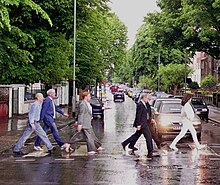
Imitating the cover of Abbey Road has become popular with fans
The image of the Beatles on the crossing has become one of the most famous and imitated in recording history. The crossing is a popular destination for Beatles fans and there is a webcam featuring it. In December 2010, the crossing was given grade II listed status for its "cultural and historical importance"; the Abbey Road studios themselves had been given similar status earlier in the year. In 2013, Kolkata Police launched a traffic safety awareness advertisement against jaywalking, using the cover and a caption that read: "If they can, why can't you?" The cover has been parodied on several occasions, not least from McCartney's own 1993 live album, Paul Is Live. The Red Hot Chili Peppers' The Abbey Road E.P. parodies the cover with the band crossing a similar zebra crossing near-naked, though the musical content is different.
Critical reception―
AllMusic ― 5/5
The A.V. Club ― A
Consequence of Sound ― A+
The Daily Telegraph ― 5/5
Down Beat ― 4/5
Encyclopedia of Popular Music ― 5/5
MusicHound ― 5/5
Paste ― 100/100
Pitchfork Media ― 10/10[
The Rolling Stone Album Guide ― 5/5
Abbey Road received mixed reviews from contemporary music critics, who criticised the production's artificial sounds and viewed its music as inauthentic. William Mann of the London Times said that the album will "be called gimmicky by people who want a record to sound exactly like a live performance",[108] although he considered it to be "teem[ing] with musical invention" and added: "Nice as Come Together and Harrison's Something are – they are minor pleasures in the context of the whole disc … Side Two is marvellous …" Ed Ward of Rolling Stone called the album "complicated instead of complex" and felt that the Moog synthesizer "disembodies and artificializes" the band's sound, adding that they "create a sound that could not possibly exist outside the studio". While he found the medley on side two to be their "most impressive music" since Rubber Soul, Nik Cohn of The New York Times said that, "individually", the album's songs are "nothing special". Albert Goldman of Life magazine wrote that Abbey Road "is not one of the Beatles' great albums" and, despite some "lovely" phrases and "stirring" segues, side two's suite "seems symbolic of the Beatles' latest phase, which might be described as the round-the-clock production of disposable music effects".
Conversely, Chris Welch wrote in Melody Maker: "the truth is, their latest LP is just a natural born gas, entirely free of pretension, deep meanings or symbolism … While production is simple compared to past intricacies, it is still extremely sophisticated and inventive." Derek Jewell of The Sunday Times found the album "refreshingly terse and unpretentious", and although he lamented the band's "cod-1920s jokes (Maxwell's Silver Hammer) and … Ringo's obligatory nursery arias (Octopus's Garden)", he considered that Abbey Road "touches higher peaks than did their last album". John Mendelsohn, writing for Rolling Stone, called it "breathtakingly recorded" and praised side two especially, equating it to "the whole of Sgt. Pepper" and stating, "That the Beatles can unify seemingly countless musical fragments and lyrical doodlings into a uniformly wonderful suite ... seems potent testimony that no, they've far from lost it, and no, they haven't stopped trying."
Retrospective reviews ―
Many critics have since cited Abbey Road as the Beatles' greatest album. In a retrospective review, Nicole Pensiero of PopMatters called it "an amazingly cohesive piece of music, innovative and timeless". Mark Kemp of Paste viewed the album as being "among The Beatles' finest works, even if it foreshadows the cigarette-lighter-waving arena rock that technically skilled but critically maligned artists from Journey to Meatloaf would belabor throughout the '70s and '80s". Neil McCormack of The Daily Telegraph dubbed it the Beatles' "last love letter to the world" and praised its "big, modern sound", calling it "lush, rich, smooth, epic, emotional and utterly gorgeous".[100] AllMusic's Richie Unterberger felt that the album shared Sgt. Pepper's "faux-conceptual forms", but had "stronger compositions", and wrote of its standing in the band's catalogue: "Whether Abbey Road is the Beatles' best work is debatable, but it's certainly the most immaculately produced (with the possible exception of Sgt. Pepper) and most tightly constructed." Ian MacDonald gave a mixed opinion of the album, noting that several tracks had been written at least a year previously, and would possibly have been unsuitable without being integrated into the medley on side two. He did, however, praise the production, particularly the sound of Starr's bass drum.
Abbey Road received high rankings in several "best albums in history" polls by critics and publications. Time included it in their 2006 list of the All-Time 100 Albums. In 2009, readers of Rolling Stone named Abbey Road the greatest Beatles album. and in 2012, the magazine ranked it number 14 on its list of the 500 greatest albums of all time. The album was also included in the book 1001 Albums You Must Hear Before You Die.
Musicologist Walter Everett interprets that most of the lyrics on side two's medley deal with "selfishness and self-gratification – the financial complaints in 'You Never Give Me Your Money,' the miserliness of Mr. Mustard, the holding back of the pillow in 'Carry That Weight,' the desire that some second person will visit the singer's dreams – perhaps the 'one sweet dream' of 'You Never Give Me Your Money'? – in 'The End.'" Everett adds that the medley's "selfish moments" are played in the context of the tonal centre of A, while "generosity" is expressed in songs where C major is central. The medley concludes with a "great compromise in the 'negotiations'" in "The End", which serves as a structurally balanced coda. In response to the repeated A-major choruses of "love you", McCartney sings in realisation that there is as much self-gratifying love ("the love you take") as there is of the generous love ("the love you make"), in A major and C major, respectively.
Commercial performance ―
Abbey Road sold four million copies in its first two months of release. In the UK, the album debuted at number 1, where it remained for 11 weeks before being displaced for one week by the Rolling Stones' Let It Bleed. The following week (which was Christmas), Abbey Road returned to the top for another six weeks (completing a total of 17 weeks) before being replaced by Led Zeppelin II. In all it spent 81 weeks on the UK albums chart.
Reaction overseas was similar. In the US, the album spent 12 weeks at number one on the Billboard Top LPs chart. It was the National Association of Recording Merchandisers (NARM) best-selling album of 1969 and was number four on Billboard magazine's top LPs of 1970 year-end chart. Abbey Road was certified 12× platinum by the RIAA in 2001.[129] In Japan, it was one of the longest-charting albums to date, remaining in the top 100 for 298 weeks during the 1970s.
In June 1970, Allen Klein reported that Abbey Road was the Beatles' best-selling album in the US with sales of about five million. By 1992, Abbey Road had sold nine million copies. The album became the ninth-most downloaded on the iTunes Store a week after it was released there on 16 November 2010.[54] A CNN report stated it was the best-selling vinyl album of 2011. It is the first album from the 1960s to sell over five million albums since 1991 when Nielsen SoundScan began tracking sales. In the US, the album had sold 7,177,797 copies by the end of the 1970s. The album has sold over 31 million copies worldwide and is one of the band's best-selling albums.
Cover versions ―
The songs on Abbey Road have been covered many times and the album itself has been covered in its entirety. One month after Abbey Road's release, George Benson recorded a cover version of the album called The Other Side of Abbey Road. Later in 1969 Booker T. & the M.G.'s recorded McLemore Avenue (the location of Stax Records) which covered the Abbey Road songs and had a similar cover photo.
Additionally, several artists have covered some or all of the side-B medley, including Phil Collins (for the Martin/Beatles tribute album In My Life), The String Cheese Incident, Transatlantic and Tenacious D (who performed the medley with Phish keyboardist Page McConnell). Furthur, a jam band including former Grateful Dead members Bob Weir and Phil Lesh, played the entire Abbey Road album during its Spring Tour 2011. It began with a "Come Together" opener at Boston on 4 March and ended with the entire medley in New York City on 15 March, including "Her Majesty" as an encore.
Release history ―
Abbey Road has remained in print since its first release in 1969. The original album was released on 26 September in the UK and 1 October in the US on Apple Records. It was reissued on vinyl in the US under Capitol on 27 December 1978,[145] while a CD reissue of the album was released in 1987, with a remastered version appearing in 2009. The remaster included additional photographs with additional liner notes and the first, limited edition, run also included a short documentary about the making of the album.
The album continues to be reissued on vinyl. It was included as part of the Beatles' Collector's Crate series in September 2009 and saw a remastered LP release on 180-gram vinyl in 2012.
Track listing ―
All tracks written by Lennon–McCartney, except where noted.
Side one1. "Come Together" Lennon 4:20
2. "Something" (George Harrison) Harrison 3:03
3. "Maxwell's Silver Hammer" McCartney 3:27
4. "Oh! Darling" McCartney 3:26
5. "Octopus's Garden" (Richard Starkey) Starr 2:51
6. "I Want You (She's So Heavy)" Lennon 7:47
Side two1. "Here Comes the Sun" (George Harrison) Harrison 3:05
2. "Because" Lennon, McCartney and Harrison 2:45
3. "You Never Give Me Your Money" McCartney 4:02
4. "Sun King" Lennon, with McCartney and Harrison 2:26
5. "Mean Mr. Mustard" Lennon 1:06
6. "Polythene Pam" Lennon 1:12
7. "She Came in Through the Bathroom Window" McCartney 1:57
8. "Golden Slumbers" McCartney 1:31
9. "Carry That Weight" McCartney, Lennon, Harrison, and Starr 1:36
10. "The End" McCartney 2:05
11. "Her Majesty" McCartney 0:23
Total length: 47:02
Notes
"Her Majesty" appears as a hidden track. Between "The End" and "Her Majesty" is 14 seconds of silence. Later releases of the album included the song on the track listing.
Some cassette tape versions in the UK and US had "Come Together" and "Here Comes the Sun" swapped to even out the playing time of each side.
Personnel[edit]
According to Mark Lewisohn, Alan W. Pollack, Ian MacDonald and Barry Miles.
The Beatles ―
John Lennon – Lead, harmony and background vocals; lead and rhythm guitars; acoustic and electric pianos, Hammond organ and Moog synthesizer; white noise generator and sound effects; percussion
Paul McCartney – Lead, harmony and background vocals; lead, rhythm and bass guitars; acoustic and electric pianos, Hammond organ and Moog synthesizer; sound effects; wind chimes, handclaps and percussion
George Harrison – Harmony and background vocals; lead, rhythm and bass guitars; Hammond organ, harmonium and Moog synthesizer; handclaps and percussion; lead vocals (on "Something" and "Here Comes the Sun")
Ringo Starr – Drums and percussion; background vocals; lead vocals (on "Octopus's Garden")
Additional musicians ―
George Martin – piano, harpsichord, organ and harmonium; percussion
Billy Preston – Hammond organ (on "Something" and "I Want You (She's So Heavy)")
Mal Evans – "anvil" (on "Maxwell's Silver Hammer")
Production ―
From Wikipedia, Rolling Stone, Google and About.com ―
Abbey Road is the eleventh studio album by English rock band the Beatles, released on 26 September 1969 by Apple Records. The recording sessions for the album were the last in which all four Beatles participated. Although Let It Be was the final album that the Beatles completed before the band's dissolution in April 1970, most of the album had been recorded before the Abbey Road sessions began. A double A-side single from the album, "Something"/"Come Together", released in October, topped the Billboard chart in the US.
Abbey Road is a rock album that incorporates genres such as blues, pop, and progressive rock, and it makes prominent use of the Moog synthesizer and the Leslie speaker. Side two contains a medley of song fragments edited together to form a single piece. The album was recorded amid a more collegial atmosphere than the Get Back/Let It Be sessions earlier in the year, but there were still frequent disagreements within the band, particularly over Paul McCartney's song "Maxwell's Silver Hammer". John Lennon had privately left the group by the time the album was released and McCartney publicly quit the following year. A 16-minute medley of several short songs comprise the majority of side two, closing with the lyric "and in the end, the love you take is equal to the love you make".
Although Abbey Road was an immediate commercial success and reached number one in the UK and US, it initially received mixed reviews, some critics describing its music as inauthentic and bemoaning the production's artificial effects. Many critics now view the album as the Beatles' best and rank it as one of the greatest albums of all time. In particular, George Harrison's contributions, "Something" and "Here Comes the Sun", are considered to be among the best songs he wrote for the group. The album's cover features the four band members walking across a zebra crossing outside Abbey Road Studios and has become one of the most famous and imitated images in the history of recorded music. As of 2011, Abbey Road remains one of the Beatles' best-selling albums.
Background ―
After the unpleasant recording sessions for the proposed Get Back album (ultimately released in 1970 as Let It Be), Paul McCartney suggested to music producer George Martin that the group get together and make an album "the way we used to do it", free of the conflict that had begun following the death of Brian Epstein and carried over to the sessions for the White Album. Martin agreed, but on the strict condition that all the group – particularly John Lennon – allow him to produce the record in the same manner as earlier albums and that discipline would be adhered to.
The first sessions for Abbey Road began on 22 February 1969, only three weeks after the Get Back sessions, in Trident Studios. There, the group recorded a backing track to "I Want You (She's So Heavy)" with Billy Preston accompanying them on Hammond organ. No further group recording occurred until April because of Ringo Starr's commitments on the film The Magic Christian. After a small amount of work that month and a session for "You Never Give Me Your Money" on 6 May, the group took an eight-week break before recommencing on 2 July. Recording continued through July and August, with the last backing track, for "Because", being taped on 1 August. Overdubs continued through the month, with the final sequencing of the album coming together on 20 August – the last time all four Beatles appeared in a studio together.
McCartney, Starr and Martin have reported positive recollections of the sessions, while George Harrison said, "we did actually perform like musicians again". Lennon and McCartney had enjoyed working together on the non-album single "The Ballad of John and Yoko" in April, contributing friendly banter between takes, and some of this camaraderie carried over to the Abbey Road sessions. Nevertheless, there was a significant amount of tension between the group members. According to author Ian MacDonald, McCartney had an acrimonious argument with Lennon during the sessions. Lennon's wife Yoko Ono had become a permanent presence at Beatles recordings and clashed with other members. Halfway through recording in June, Lennon and Ono were involved in a car accident. A doctor told Ono to rest in bed, so Lennon had one installed in the studio so she could observe the recording process from there.
The album's two halves represented a compromise; Lennon wanted a traditional release with distinct and unrelated songs while McCartney and Martin wanted to continue their thematic approach from Sgt. Pepper's Lonely Hearts Club Band by incorporating a medley. Lennon ultimately said that he disliked Abbey Road as a whole and felt that it lacked authenticity, calling McCartney's contributions "[music] for the grannies to dig" and not "real songs" and describing the medley as "junk ... just bits of songs thrown together". During the sessions, Lennon expressed a desire to have all of his songs on one side of the album, with McCartney's on the other.
Nobody was entirely sure that the work was going to be the group's last, though Harrison said "it felt as if we were reaching the end of the line". After the album was released, the Get Back/Let It Be project was re-examined, and work on it continued into 1970. Therefore, Let It Be became the last album to be finished by the Beatles, even though its recording had begun before Abbey Road.
By September 1969, after the recording of Abbey Road, Lennon had formed a new group, the Plastic Ono Band, in part because the Beatles had rejected his song "Cold Turkey". While Harrison worked with such artists as Leon Russell, Doris Troy, Preston and Delaney & Bonnie through to the end of the year, McCartney took a hiatus from the group after his daughter Mary was born on 28 August. On 20 September, Lennon formally announced his departure to the other Beatles. Abbey Road was released on 26 September 1969. The single "Something"/"Come Together" followed in October, while Lennon released the Plastic Ono Band's version of "Cold Turkey" the same month. The Beatles did not promote Abbey Road directly, and no public announcement was made of the band's split until McCartney announced he was leaving the group in April 1970, at which point they officially disbanded.
After the unpleasant recording sessions for the proposed Get Back album (ultimately released in 1970 as Let It Be), Paul McCartney suggested to music producer George Martin that the group get together and make an album "the way we used to do it", free of the conflict that had begun following the death of Brian Epstein and carried over to the sessions for the White Album. Martin agreed, but on the strict condition that all the group – particularly John Lennon – allow him to produce the record in the same manner as earlier albums and that discipline would be adhered to.
The first sessions for Abbey Road began on 22 February 1969, only three weeks after the Get Back sessions, in Trident Studios. There, the group recorded a backing track to "I Want You (She's So Heavy)" with Billy Preston accompanying them on Hammond organ. No further group recording occurred until April because of Ringo Starr's commitments on the film The Magic Christian. After a small amount of work that month and a session for "You Never Give Me Your Money" on 6 May, the group took an eight-week break before recommencing on 2 July. Recording continued through July and August, with the last backing track, for "Because", being taped on 1 August. Overdubs continued through the month, with the final sequencing of the album coming together on 20 August – the last time all four Beatles appeared in a studio together.
McCartney, Starr and Martin have reported positive recollections of the sessions, while George Harrison said, "we did actually perform like musicians again". Lennon and McCartney had enjoyed working together on the non-album single "The Ballad of John and Yoko" in April, contributing friendly banter between takes, and some of this camaraderie carried over to the Abbey Road sessions. Nevertheless, there was a significant amount of tension between the group members. According to author Ian MacDonald, McCartney had an acrimonious argument with Lennon during the sessions. Lennon's wife Yoko Ono had become a permanent presence at Beatles recordings and clashed with other members. Halfway through recording in June, Lennon and Ono were involved in a car accident. A doctor told Ono to rest in bed, so Lennon had one installed in the studio so she could observe the recording process from there.
The album's two halves represented a compromise; Lennon wanted a traditional release with distinct and unrelated songs while McCartney and Martin wanted to continue their thematic approach from Sgt. Pepper's Lonely Hearts Club Band by incorporating a medley. Lennon ultimately said that he disliked Abbey Road as a whole and felt that it lacked authenticity, calling McCartney's contributions "[music] for the grannies to dig" and not "real songs" and describing the medley as "junk ... just bits of songs thrown together". During the sessions, Lennon expressed a desire to have all of his songs on one side of the album, with McCartney's on the other.
Nobody was entirely sure that the work was going to be the group's last, though Harrison said "it felt as if we were reaching the end of the line". After the album was released, the Get Back/Let It Be project was re-examined, and work on it continued into 1970. Therefore, Let It Be became the last album to be finished by the Beatles, even though its recording had begun before Abbey Road.
By September 1969, after the recording of Abbey Road, Lennon had formed a new group, the Plastic Ono Band, in part because the Beatles had rejected his song "Cold Turkey". While Harrison worked with such artists as Leon Russell, Doris Troy, Preston and Delaney & Bonnie through to the end of the year, McCartney took a hiatus from the group after his daughter Mary was born on 28 August. On 20 September, Lennon formally announced his departure to the other Beatles. Abbey Road was released on 26 September 1969. The single "Something"/"Come Together" followed in October, while Lennon released the Plastic Ono Band's version of "Cold Turkey" the same month. The Beatles did not promote Abbey Road directly, and no public announcement was made of the band's split until McCartney announced he was leaving the group in April 1970, at which point they officially disbanded.
Composition and recording ―
Side one
"Come Together"
"Come Together" was an expansion of "Let's Get It Together", a song Lennon originally wrote for Timothy Leary's California gubernatorial campaign against Ronald Reagan.[23]A rough version of the lyrics for "Come Together" was written at Lennon's and Ono's second bed-in event in Montreal.
Beatles author Jonathan Gould suggested that the song has only a single "pariah-like protagonist" and Lennon was "painting another sardonic self-portrait". MacDonald has suggested that the "juju eyeballs" has been claimed to refer to Dr John and "spinal cracker" to Ono. The song was later the subject of a lawsuit brought against Lennon by Morris Levy because the opening line in "Come Together" – "Here come old flat-top" – was admittedly lifted from a line in Chuck Berry's "You Can't Catch Me". A settlement was reached in 1973 whereby Lennon promised to record three songs from Levy's publishing catalogue for his next album.
"Come Together" was later released as a double A-side single with "Something". In the liner notes to the compilation album Love, Martin described the track as "a simple song but it stands out because of the sheer brilliance of the performers".
Side one
"Come Together"
"Come Together" was an expansion of "Let's Get It Together", a song Lennon originally wrote for Timothy Leary's California gubernatorial campaign against Ronald Reagan.[23]A rough version of the lyrics for "Come Together" was written at Lennon's and Ono's second bed-in event in Montreal.
Beatles author Jonathan Gould suggested that the song has only a single "pariah-like protagonist" and Lennon was "painting another sardonic self-portrait". MacDonald has suggested that the "juju eyeballs" has been claimed to refer to Dr John and "spinal cracker" to Ono. The song was later the subject of a lawsuit brought against Lennon by Morris Levy because the opening line in "Come Together" – "Here come old flat-top" – was admittedly lifted from a line in Chuck Berry's "You Can't Catch Me". A settlement was reached in 1973 whereby Lennon promised to record three songs from Levy's publishing catalogue for his next album.
"Come Together" was later released as a double A-side single with "Something". In the liner notes to the compilation album Love, Martin described the track as "a simple song but it stands out because of the sheer brilliance of the performers".
"Something"
Harrison was inspired to write "Something" during sessions for the White Album by listening to label-mate James Taylor's "Something in the Way She Moves" from his album James Taylor. After the lyrics were refined during the Let It Be sessions (tapes reveal Lennon giving Harrison some songwriting advice during its composition), the song was initially given to Joe Cocker, but was subsequently recorded for Abbey Road. Cocker's version appeared on his album Joe Cocker! that November.
"Something" was Lennon's favourite song on the album, and McCartney considered it the best song Harrison had written. Frank Sinatra once commented that it was his favourite Lennon–McCartney composition (though the song was actually Harrison's) and "the greatest love song ever written". Lennon contributed piano to the recording and while most of the part was removed, traces of it remain in the final cut, notably on the middle eight, prior to Harrison's guitar solo.
The song was issued as a double A-side single with "Come Together" in October 1969 and topped the US charts for one week, becoming the first Beatles number-one single that was not a Lennon–McCartney composition; it was also the first Beatles single from an already released album. Apple's Neil Aspinall filmed a promotional video, which combined separate footage of the Beatles and their wives.
"Something" was Lennon's favourite song on the album, and McCartney considered it the best song Harrison had written. Frank Sinatra once commented that it was his favourite Lennon–McCartney composition (though the song was actually Harrison's) and "the greatest love song ever written". Lennon contributed piano to the recording and while most of the part was removed, traces of it remain in the final cut, notably on the middle eight, prior to Harrison's guitar solo.
The song was issued as a double A-side single with "Come Together" in October 1969 and topped the US charts for one week, becoming the first Beatles number-one single that was not a Lennon–McCartney composition; it was also the first Beatles single from an already released album. Apple's Neil Aspinall filmed a promotional video, which combined separate footage of the Beatles and their wives.
"Maxwell's Silver Hammer"
"Maxwell's Silver Hammer", McCartney's first song on the album, was first performed by the Beatles during the Let It Be sessions (as can be seen in the film). He wrote the song after the group's trip to India in 1968 and wanted to record it for the White Album, but it was rejected by the others as "too complicated".
The recording was fraught with tension between band members, as McCartney annoyed others by insisting on a perfect performance. The track was the first Lennon was invited to work on following his car accident, but he hated it and declined to do so. According to engineer Geoff Emerick, Lennon said it was "more of Paul's granny music" and left the session. He spent the next two weeks with Ono and did not return to the studio until the backing track for "Come Together" was laid down on 21 July. Harrison was also tired of the song, adding "we had to play it over and over again until Paul liked it. It was a real drag". Starr was more sympathetic to the song. "It was granny music", he admitted, "but we needed stuff like that on our album so other people would listen to it". Roadie and assistant Mal Evans played the anvil sound in the chorus. This track also makes use of Harrison's Moog Synthesizer, played by McCartney.
"Oh! Darling"
"Oh! Darling" was written by McCartney in the doo-wop style, similar to contemporary work by Frank Zappa. It was tried at the Get Back sessions, and a version appears on Anthology 3. It was subsequently re-recorded in April, with overdubs in July and August.
McCartney attempted recording the lead vocal only once a day. He said: "I came into the studios early every day for a week to sing it by myself because at first my voice was too clear. I wanted it to sound as though I'd been performing it on stage all week." Lennon thought he should have sung it, remarking that it was more his style.
"Oh! Darling" was written by McCartney in the doo-wop style, similar to contemporary work by Frank Zappa. It was tried at the Get Back sessions, and a version appears on Anthology 3. It was subsequently re-recorded in April, with overdubs in July and August.
McCartney attempted recording the lead vocal only once a day. He said: "I came into the studios early every day for a week to sing it by myself because at first my voice was too clear. I wanted it to sound as though I'd been performing it on stage all week." Lennon thought he should have sung it, remarking that it was more his style.
"Octopus's Garden"
As was the case with most of the Beatles' albums, Starr sang lead vocal on one track. "Octopus's Garden" is his second and last solo composition released on any album by the band. It was inspired by a trip to Sardinia aboard Peter Sellers' yacht after Starr left the band for two weeks with his family during the sessions for the White Album. Starr received a full songwriting credit and composed most of the lyrics, though the song's melodic structure was partly written in the studio by Harrison. The pair would later collaborate as writers on Starr's solo singles "It Don't Come Easy", "Back Off Boogaloo" and "Photograph".
"I Want You (She's So Heavy)"
John Lennon played the Moog synthesizer's white noise generator to create the "wind" sounds at the end of "I Want You (She's So Heavy)"
"I Want You (She's So Heavy)" was written by Lennon about his relationship with Ono, and he made a deliberate choice to keep the lyrics simple and concise. Author Tom Maginnis thought the song had a progressive rock influence, with its unusual length and structure, repeating guitar riff, and white noise effects, though he noted the "I Want You" section has a straightforward blues structure.
The finished song is a combination of two different recording attempts. The first attempt occurred almost immediately after the Get Back/Let It Be sessions, in February 1969, with Preston. This was subsequently combined with a second version made during the Abbey Road sessions proper in April. The two sections together ran to nearly 8 minutes, making it the Beatles' second-longest released track. Lennon used Harrison's Moog synthesizer with a white noise setting to create a "wind" effect that was overdubbed on the second half of the track. During the final edit, Lennon told Emerick to "cut it right there" at 7 minutes and 44 seconds, creating a sudden, jarring silence that concludes the first side of Abbey Road (the recording tape would have run out within 20 seconds as it was). The final mixing and editing for the track occurred on 20 August 1969, the last day all four Beatles were together in the studio.
Side two
"Here Comes the Sun"
"Here Comes the Sun" was written by Harrison in Eric Clapton's garden in Surrey while Harrison took a break from stressful band business meetings. The basic track was recorded on 7 July 1969. Harrison sang lead and played acoustic guitar, McCartney provided backing vocals and played bass and Starr played the drums. Lennon was still recuperating from his car accident and did not perform on the track. Martin provided an orchestral arrangement in collaboration with Harrison, who overdubbed a Moog synthesizer part on 19 August, immediately before the final mix.
The song was not released as a single but still attracted critical praise. It has been featured several times on BBC Radio 4's Desert Island Discs, having been chosen by Sandie Shaw, Jerry Springer, Boris Johnson and Elaine Page. The Daily Telegraph's Martin Chilton said it was "almost impossible not to sing along to". Since digital downloads have become eligible to chart, it reached number 56 in 2010 after the Beatles' back catalogue was released on iTunes.
Harrison recorded a guitar solo for this track that did not appear in the final mix. It was rediscovered in 2012, and footage of Martin and Harrison's son Dhani listening to it in the studio was released on the DVD of Living in the Material World.
"Because"
"Because" was inspired by Lennon listening to Ono playing Ludwig van Beethoven's "Moonlight Sonata" on the piano. He recalled he was "lying on the sofa in our house, listening to Yoko play ... Suddenly, I said, 'Can you play those chords backward?' She did, and I wrote 'Because' around them." The track features three-part harmonies by Lennon, McCartney and Harrison, which were then triple-tracked to give nine voices in the final mix. The group considered the vocals to be some of the hardest and most complex they attempted. Harrison played the Moog synthesizer, and Martin played the harpsichord that opens the track.
Abbey Road Medley
The medley of songs on side two finished with "The End"
Side two contains a 16-minute medley of several short songs, recorded over July and August and blended into a suite by McCartney and Martin. Some songs were written (and originally recorded in demo form) during sessions for the White Album and Get Back / Let It Be, which later appeared on Anthology 3. While the idea for the medley was McCartney's, Martin claims credit for some structure, adding he "wanted to get John and Paul to think more seriously about their music".
The first track recorded for the medley was the opening number, "You Never Give Me Your Money". McCartney has claimed that the band's dispute over Allen Klein and what McCartney viewed as Klein's empty promises were the inspiration for the song's lyrics. However, MacDonald doubts this given that the backing track, recorded on 6 May at Olympic Studios, predated the worst altercations between Klein and McCartney. The track is a suite of varying styles, ranging from a piano-led ballad at the start to arpeggiated guitars at the end. Both Harrison and Lennon provided guitar solos with Lennon playing the solos at the end of the track, which Beatles author Walter Everett considers his favourite Lennon guitar contribution.
This song transitions into Lennon's "Sun King" which, like "Because", showcases Lennon, McCartney and Harrison's triple-tracked harmonies. Following it are Lennon's "Mean Mr. Mustard" (written during the Beatles' 1968 trip to India) and "Polythene Pam". These in turn are followed by four McCartney songs, "She Came in Through the Bathroom Window" (written after a fan entered McCartney's residence via his bathroom window), "Golden Slumbers" (based on Thomas Dekker's 17th-century poem set to new music), "Carry That Weight" (reprising elements from "You Never Give Me Your Money", and featuring chorus vocals from all four Beatles), and closing with "The End".
"The End" features Starr's only drum solo in the Beatles' catalogue (the drums are mixed across two tracks in "true stereo", unlike most releases at that time where they were hard panned left or right). Fifty-four seconds into the song are 18 bars of lead guitar: the first two bars are played by McCartney, the second two by Harrison, and the third two by Lennon, with the sequence repeating. Harrison suggested the idea of a guitar solo in the track, Lennon decided they should trade solos and McCartney elected to go first. The solos were cut live against the existing backing track in one take. Immediately after Lennon's third and final solo, the piano chords of the final part of the song begin. The song ends with the memorable final line, "And in the end, the love you take is equal to the love you make". This section was taped separately to the first, and required the piano to be re-recorded by McCartney, which was done on 18 August. An alternative version of the song, with Harrison's lead guitar solo played against McCartney's (with Starr's drum solo heard in the background), appears on the Anthology 3 album and the 2012 digital-only compilation album Tomorrow Never Knows.
"Her Majesty"
"Her Majesty" was recorded by McCartney on 2 July when he arrived before the rest of the group at Abbey Road. It was included in a rough mix of the side two medley, appearing between "Mean Mr. Mustard" and "Polythene Pam". McCartney disliked the way the medley sounded when it included "Her Majesty", so he asked for it to be cut. The second engineer, John Kurlander, had been instructed not to throw out anything, so after McCartney left, he attached the track to the end of the master tape after 20 seconds of silence. The tape box bore an instruction to leave "Her Majesty" off the final product, but the next day when mastering engineer Malcolm Davies received the tape, he (also trained not to throw anything away) cut a playback lacquer of the whole sequence, including "Her Majesty". The Beatles liked this effect and included it on the album.
"Her Majesty" opens with the final, crashing chord of "Mean Mr. Mustard", while the final note of "Her Majesty" remained buried in the mix of "Polythene Pam". This is the result of "Her Majesty" being snipped off the reel during a rough mix of the medley on 30 July. The medley was subsequently mixed again from scratch although "Her Majesty" was not touched again and still appears in its rough mix on the album.
Original US and UK pressings of Abbey Road do not list "Her Majesty" on the album's cover nor on the record label, making it a hidden track. The song title appears on the inlay card and disc of the 1987 remastered CD reissue, as track 17. It also appears on the sleeve, booklet and disc of the 2009 remastered CD reissue, but not on the cover or record label of the 2012 vinyl reissue.
"Her Majesty" opens with the final, crashing chord of "Mean Mr. Mustard", while the final note of "Her Majesty" remained buried in the mix of "Polythene Pam". This is the result of "Her Majesty" being snipped off the reel during a rough mix of the medley on 30 July. The medley was subsequently mixed again from scratch although "Her Majesty" was not touched again and still appears in its rough mix on the album.
Original US and UK pressings of Abbey Road do not list "Her Majesty" on the album's cover nor on the record label, making it a hidden track. The song title appears on the inlay card and disc of the 1987 remastered CD reissue, as track 17. It also appears on the sleeve, booklet and disc of the 2009 remastered CD reissue, but not on the cover or record label of the 2012 vinyl reissue.
Unreleased material ―
Three days after the session for "I Want You (She's So Heavy)", Harrison recorded solo demos of "All Things Must Pass" (which became the title track of his 1970 triple album), "Something" and "Old Brown Shoe". The latter was re-recorded by the Beatles in April 1969 and issued as the B-side to "The Ballad of John and Yoko" the following month. All three of these Harrison demos were later featured on Anthology 3.
During the sessions for the medley, McCartney recorded "Come and Get It", playing all the instruments. It was assumed to be a demo recording for another artist but McCartney later said that he originally intended to put it on Abbey Road. It was instead covered by Badfinger, while McCartney's original recording appeared on Anthology 3.
The original backing track to "Something", featuring a piano-led coda,[31] and "You Never Give Me Your Money", which leads into a fast rock-n-roll jam session,[60] have appeared on bootlegs.
Production ―
An EMI TG mixing desk, similar to this one, was used in the production of Abbey Road
Abbey Road was recorded on professional eight-track reel to reel tape machines rather than the four-track machines that were used for earlier Beatles albums such as Sgt Pepper, and was the first Beatles album not to be issued in mono. The album makes prominent use of the Moog synthesizer, and the guitar played through a Leslie speaker. The Moog is not merely as a background effect but sometimes playing a central role, as in "Because" where it is used for the middle eight. It is also prominent on "Maxwell's Silver Hammer" (played using a ribbon strip) and "Here Comes the Sun". The instrument was introduced to the band by Harrison who acquired one in November 1968 and subsequently used it to create his Electronic Sound album. Starr made more prominent use of the tom-toms on Abbey Road, later saying the album was "tom-tom madness ... I went nuts on the toms."
Abbey Road was also the first and only Beatles album to be entirely recorded through a solid state transistor mixing desk, the TG12345 Mk I, as opposed to earlier thermionic valve based REDD desks. The TG console also allowed better support for eight-track multitrack recording, helping the Beatles' considerable use of overdubbing. Emerick recalls the TG desk used to record the album had individual limiters and compressors on each audio channel and noted the overall sound was "softer" than the earlier valve desks.
One of the assistant engineers working on the album was a 19-year-old Alan Parsons. He went on to engineer Pink Floyd's landmark album The Dark Side of the Moon and produce many popular albums himself with the Alan Parsons Project. Kurlander also assisted on many of the sessions, and went on to become a successful engineer and producer, most noteworthy for his success on the scores for The Lord of the Rings film trilogy.
Album cover ―
The cover was designed by Apple Records creative director Kosh. It is the only original UK Beatles album sleeve to show neither the artist name nor the album title on its front cover, which was Kosh's idea, despite EMI claiming the record would not sell without this information. He later explained that "we didn't need to write the band's name on the cover ... They were the most famous band in the world".
Imagery ―
The zebra crossing, with EMI Studios in the background, in 1969
The front cover design, a photograph of the group on a zebra crossing, was based on ideas sketched by McCartney, and taken on 8 August 1969 outside EMI Studios in Abbey Road. At 11:35 that morning, photographer Iain Macmillan was given only ten minutes to take the photo whilst he stood on a step-ladder and a policeman held up traffic behind the camera. Macmillan took six photographs, which McCartney later examined with a magnifying glass before deciding which of the shots would be used upon the album sleeve.
In the image selected by McCartney, the group walk across the street in single file from left to right, with Lennon leading, followed by Starr, McCartney, and Harrison. McCartney is barefoot and out of step with the other members. Apart from Harrison, the group are wearing suits designed by Tommy Nutter. To the left of the picture, parked next to the zebra crossing, is a white Volkswagen Beetle which belonged to one of the people living in the block of flats across from the recording studio. After the album was released, the number plate (LMW 281F) was stolen repeatedly from the car. In 1986, the car was sold at auction for £2,530 and in 2001 was on display in a museum in Germany. The man standing on the pavement to the right of the picture is Paul Cole (7 July 1911 – 13 February 2008),[90] an American tourist unaware he had been photographed until he saw the album cover months later. On the original cover, McCartney holds a cigarette; in 2003 several US poster companies airbrushed this cigarette out of the image, without permission from either Apple or McCartney.
Legacy ―
Imitating the cover of Abbey Road has become popular with fans
The image of the Beatles on the crossing has become one of the most famous and imitated in recording history. The crossing is a popular destination for Beatles fans and there is a webcam featuring it. In December 2010, the crossing was given grade II listed status for its "cultural and historical importance"; the Abbey Road studios themselves had been given similar status earlier in the year. In 2013, Kolkata Police launched a traffic safety awareness advertisement against jaywalking, using the cover and a caption that read: "If they can, why can't you?" The cover has been parodied on several occasions, not least from McCartney's own 1993 live album, Paul Is Live. The Red Hot Chili Peppers' The Abbey Road E.P. parodies the cover with the band crossing a similar zebra crossing near-naked, though the musical content is different.
Critical reception―
AllMusic ― 5/5
The A.V. Club ― A
Consequence of Sound ― A+
The Daily Telegraph ― 5/5
Down Beat ― 4/5
Encyclopedia of Popular Music ― 5/5
MusicHound ― 5/5
Paste ― 100/100
Pitchfork Media ― 10/10[
The Rolling Stone Album Guide ― 5/5
Abbey Road received mixed reviews from contemporary music critics, who criticised the production's artificial sounds and viewed its music as inauthentic. William Mann of the London Times said that the album will "be called gimmicky by people who want a record to sound exactly like a live performance",[108] although he considered it to be "teem[ing] with musical invention" and added: "Nice as Come Together and Harrison's Something are – they are minor pleasures in the context of the whole disc … Side Two is marvellous …" Ed Ward of Rolling Stone called the album "complicated instead of complex" and felt that the Moog synthesizer "disembodies and artificializes" the band's sound, adding that they "create a sound that could not possibly exist outside the studio". While he found the medley on side two to be their "most impressive music" since Rubber Soul, Nik Cohn of The New York Times said that, "individually", the album's songs are "nothing special". Albert Goldman of Life magazine wrote that Abbey Road "is not one of the Beatles' great albums" and, despite some "lovely" phrases and "stirring" segues, side two's suite "seems symbolic of the Beatles' latest phase, which might be described as the round-the-clock production of disposable music effects".
Conversely, Chris Welch wrote in Melody Maker: "the truth is, their latest LP is just a natural born gas, entirely free of pretension, deep meanings or symbolism … While production is simple compared to past intricacies, it is still extremely sophisticated and inventive." Derek Jewell of The Sunday Times found the album "refreshingly terse and unpretentious", and although he lamented the band's "cod-1920s jokes (Maxwell's Silver Hammer) and … Ringo's obligatory nursery arias (Octopus's Garden)", he considered that Abbey Road "touches higher peaks than did their last album". John Mendelsohn, writing for Rolling Stone, called it "breathtakingly recorded" and praised side two especially, equating it to "the whole of Sgt. Pepper" and stating, "That the Beatles can unify seemingly countless musical fragments and lyrical doodlings into a uniformly wonderful suite ... seems potent testimony that no, they've far from lost it, and no, they haven't stopped trying."
Retrospective reviews ―
Many critics have since cited Abbey Road as the Beatles' greatest album. In a retrospective review, Nicole Pensiero of PopMatters called it "an amazingly cohesive piece of music, innovative and timeless". Mark Kemp of Paste viewed the album as being "among The Beatles' finest works, even if it foreshadows the cigarette-lighter-waving arena rock that technically skilled but critically maligned artists from Journey to Meatloaf would belabor throughout the '70s and '80s". Neil McCormack of The Daily Telegraph dubbed it the Beatles' "last love letter to the world" and praised its "big, modern sound", calling it "lush, rich, smooth, epic, emotional and utterly gorgeous".[100] AllMusic's Richie Unterberger felt that the album shared Sgt. Pepper's "faux-conceptual forms", but had "stronger compositions", and wrote of its standing in the band's catalogue: "Whether Abbey Road is the Beatles' best work is debatable, but it's certainly the most immaculately produced (with the possible exception of Sgt. Pepper) and most tightly constructed." Ian MacDonald gave a mixed opinion of the album, noting that several tracks had been written at least a year previously, and would possibly have been unsuitable without being integrated into the medley on side two. He did, however, praise the production, particularly the sound of Starr's bass drum.
Abbey Road received high rankings in several "best albums in history" polls by critics and publications. Time included it in their 2006 list of the All-Time 100 Albums. In 2009, readers of Rolling Stone named Abbey Road the greatest Beatles album. and in 2012, the magazine ranked it number 14 on its list of the 500 greatest albums of all time. The album was also included in the book 1001 Albums You Must Hear Before You Die.
Musicologist Walter Everett interprets that most of the lyrics on side two's medley deal with "selfishness and self-gratification – the financial complaints in 'You Never Give Me Your Money,' the miserliness of Mr. Mustard, the holding back of the pillow in 'Carry That Weight,' the desire that some second person will visit the singer's dreams – perhaps the 'one sweet dream' of 'You Never Give Me Your Money'? – in 'The End.'" Everett adds that the medley's "selfish moments" are played in the context of the tonal centre of A, while "generosity" is expressed in songs where C major is central. The medley concludes with a "great compromise in the 'negotiations'" in "The End", which serves as a structurally balanced coda. In response to the repeated A-major choruses of "love you", McCartney sings in realisation that there is as much self-gratifying love ("the love you take") as there is of the generous love ("the love you make"), in A major and C major, respectively.
Commercial performance ―
Abbey Road sold four million copies in its first two months of release. In the UK, the album debuted at number 1, where it remained for 11 weeks before being displaced for one week by the Rolling Stones' Let It Bleed. The following week (which was Christmas), Abbey Road returned to the top for another six weeks (completing a total of 17 weeks) before being replaced by Led Zeppelin II. In all it spent 81 weeks on the UK albums chart.
Reaction overseas was similar. In the US, the album spent 12 weeks at number one on the Billboard Top LPs chart. It was the National Association of Recording Merchandisers (NARM) best-selling album of 1969 and was number four on Billboard magazine's top LPs of 1970 year-end chart. Abbey Road was certified 12× platinum by the RIAA in 2001.[129] In Japan, it was one of the longest-charting albums to date, remaining in the top 100 for 298 weeks during the 1970s.
In June 1970, Allen Klein reported that Abbey Road was the Beatles' best-selling album in the US with sales of about five million. By 1992, Abbey Road had sold nine million copies. The album became the ninth-most downloaded on the iTunes Store a week after it was released there on 16 November 2010.[54] A CNN report stated it was the best-selling vinyl album of 2011. It is the first album from the 1960s to sell over five million albums since 1991 when Nielsen SoundScan began tracking sales. In the US, the album had sold 7,177,797 copies by the end of the 1970s. The album has sold over 31 million copies worldwide and is one of the band's best-selling albums.
Cover versions ―
The songs on Abbey Road have been covered many times and the album itself has been covered in its entirety. One month after Abbey Road's release, George Benson recorded a cover version of the album called The Other Side of Abbey Road. Later in 1969 Booker T. & the M.G.'s recorded McLemore Avenue (the location of Stax Records) which covered the Abbey Road songs and had a similar cover photo.
Additionally, several artists have covered some or all of the side-B medley, including Phil Collins (for the Martin/Beatles tribute album In My Life), The String Cheese Incident, Transatlantic and Tenacious D (who performed the medley with Phish keyboardist Page McConnell). Furthur, a jam band including former Grateful Dead members Bob Weir and Phil Lesh, played the entire Abbey Road album during its Spring Tour 2011. It began with a "Come Together" opener at Boston on 4 March and ended with the entire medley in New York City on 15 March, including "Her Majesty" as an encore.
Release history ―
Abbey Road has remained in print since its first release in 1969. The original album was released on 26 September in the UK and 1 October in the US on Apple Records. It was reissued on vinyl in the US under Capitol on 27 December 1978,[145] while a CD reissue of the album was released in 1987, with a remastered version appearing in 2009. The remaster included additional photographs with additional liner notes and the first, limited edition, run also included a short documentary about the making of the album.
The album continues to be reissued on vinyl. It was included as part of the Beatles' Collector's Crate series in September 2009 and saw a remastered LP release on 180-gram vinyl in 2012.
Track listing ―
All tracks written by Lennon–McCartney, except where noted.
Side one1. "Come Together" Lennon 4:20
2. "Something" (George Harrison) Harrison 3:03
3. "Maxwell's Silver Hammer" McCartney 3:27
4. "Oh! Darling" McCartney 3:26
5. "Octopus's Garden" (Richard Starkey) Starr 2:51
6. "I Want You (She's So Heavy)" Lennon 7:47
Side two1. "Here Comes the Sun" (George Harrison) Harrison 3:05
2. "Because" Lennon, McCartney and Harrison 2:45
3. "You Never Give Me Your Money" McCartney 4:02
4. "Sun King" Lennon, with McCartney and Harrison 2:26
5. "Mean Mr. Mustard" Lennon 1:06
6. "Polythene Pam" Lennon 1:12
7. "She Came in Through the Bathroom Window" McCartney 1:57
8. "Golden Slumbers" McCartney 1:31
9. "Carry That Weight" McCartney, Lennon, Harrison, and Starr 1:36
10. "The End" McCartney 2:05
11. "Her Majesty" McCartney 0:23
Total length: 47:02
Notes
"Her Majesty" appears as a hidden track. Between "The End" and "Her Majesty" is 14 seconds of silence. Later releases of the album included the song on the track listing.
Some cassette tape versions in the UK and US had "Come Together" and "Here Comes the Sun" swapped to even out the playing time of each side.
Personnel[edit]
According to Mark Lewisohn, Alan W. Pollack, Ian MacDonald and Barry Miles.
The Beatles ―
John Lennon – Lead, harmony and background vocals; lead and rhythm guitars; acoustic and electric pianos, Hammond organ and Moog synthesizer; white noise generator and sound effects; percussion
Paul McCartney – Lead, harmony and background vocals; lead, rhythm and bass guitars; acoustic and electric pianos, Hammond organ and Moog synthesizer; sound effects; wind chimes, handclaps and percussion
George Harrison – Harmony and background vocals; lead, rhythm and bass guitars; Hammond organ, harmonium and Moog synthesizer; handclaps and percussion; lead vocals (on "Something" and "Here Comes the Sun")
Ringo Starr – Drums and percussion; background vocals; lead vocals (on "Octopus's Garden")
Additional musicians ―
George Martin – piano, harpsichord, organ and harmonium; percussion
Billy Preston – Hammond organ (on "Something" and "I Want You (She's So Heavy)")
Mal Evans – "anvil" (on "Maxwell's Silver Hammer")
Production ―
"Something" and "Here Comes the Sun" orchestrated and conducted by George Martin (with George Harrison)
"Golden Slumbers", "Carry That Weight" and "The End" orchestrated and conducted by George Martin (with Paul McCartney)
Produced by George Martin (with the Beatles)
Recorded by Geoff Emerick and Phil McDonald
Assistant Engineering by Alan Parsons
Mixed by Geoff Emerick, Phil McDonald and George Martin (with the Beatles)
Moog programming by Mike Vickers
"Golden Slumbers", "Carry That Weight" and "The End" orchestrated and conducted by George Martin (with Paul McCartney)
Produced by George Martin (with the Beatles)
Recorded by Geoff Emerick and Phil McDonald
Assistant Engineering by Alan Parsons
Mixed by Geoff Emerick, Phil McDonald and George Martin (with the Beatles)
Moog programming by Mike Vickers


